

A government account is supposed to be one of the safest places for public money but in Haryana, the CBI alleges that government funds were instead moved through a carefully structured network involving government officials, bank officers, fixed deposits, forged documents, shell companies and third-party accounts.
According to the agency’s latest chargesheet, the alleged benefits received by some officials went far beyond conventional cash payments.
The investigation refers to allegations involving luxury hotel like parties, “mujra” performances, escorts, gold and hawala payments. But behind those sensational details lies a more important question:
How was public money allegedly moved out of government-controlled accounts in the first place?
The Alleged Scheme: Government Funds to Private Banks to Third Parties
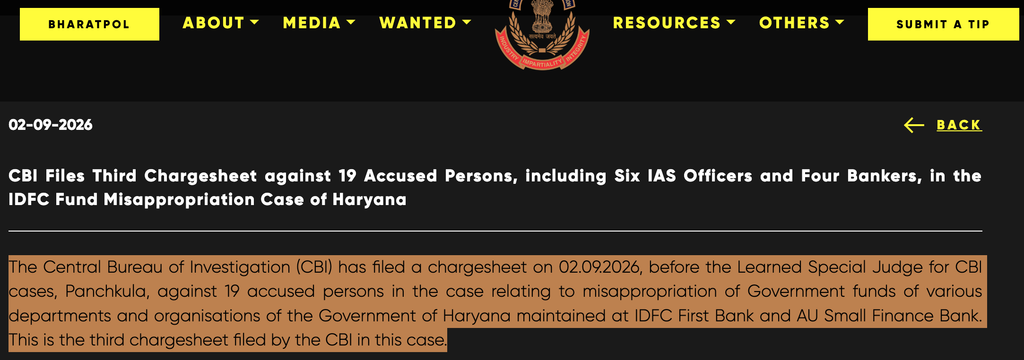
The CBI’s third chargesheet, filed before the Special CBI Court in Panchkula on September 2, 2026, names 19 accused, including six Haryana-cadre IAS officers, bank officials and other government officials. The total number of people chargesheeted in the case has now reached 37.
According to the CBI, funds belonging to 8 Haryana government departments and organisations were allegedly shifted from empanelled banks into specific branches of IDFC First Bank and AU Small Finance Bank.
Those branches were significant because, according to investigators, accused bank officials were posted there. The alleged chain was:
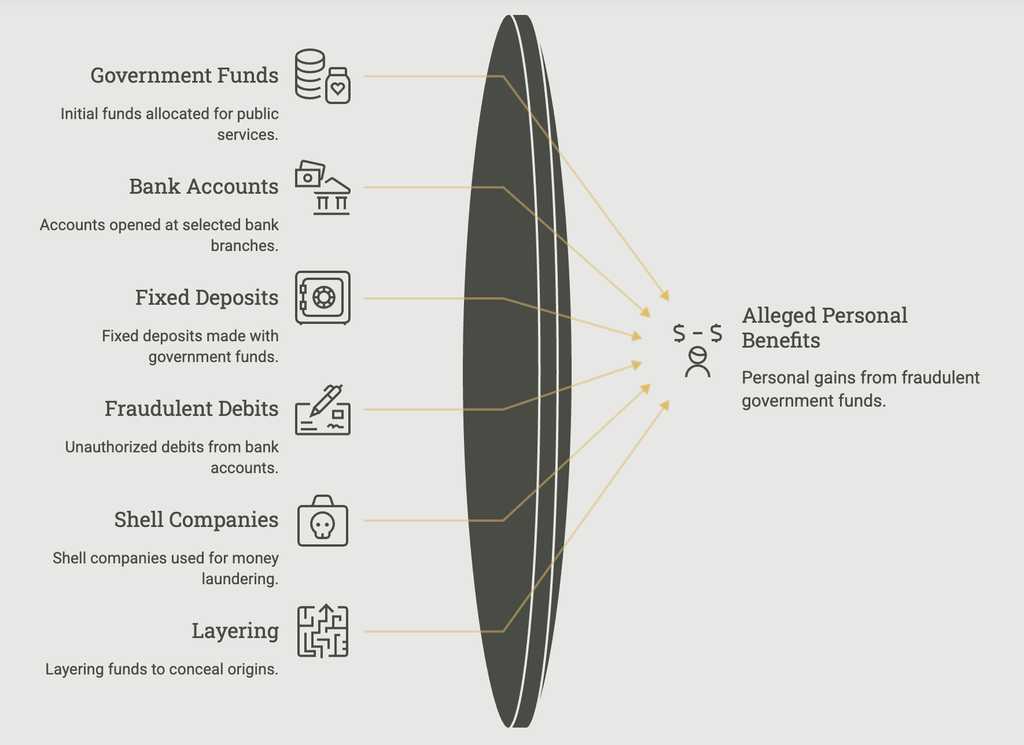
Acc. to the CBI, the alleged scheme involved violations of Haryana Finance Department guidelines on financial prudence and fraud prevention. The agency further alleges that the funds were misappropriated through fraudulent transactions and transferred to third parties, which are not connected with the government departments.
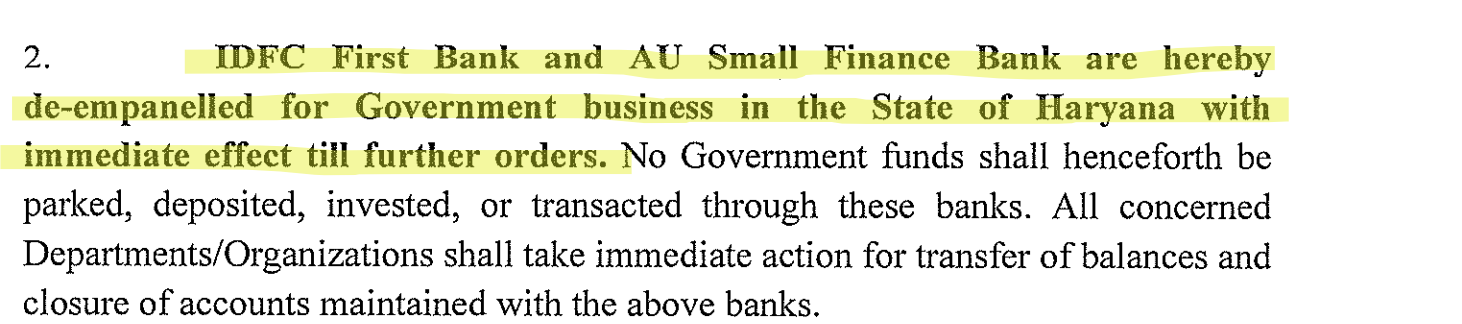
The “14% Interest” Question
One of the most revealing allegations concerns money belonging to the Haryana Power Generation Corporation Limited (HPGCL). The CBI alleges that an existing, interest-earning fixed deposit with another bank was prematurely broken and moved to IDFC First Bank.
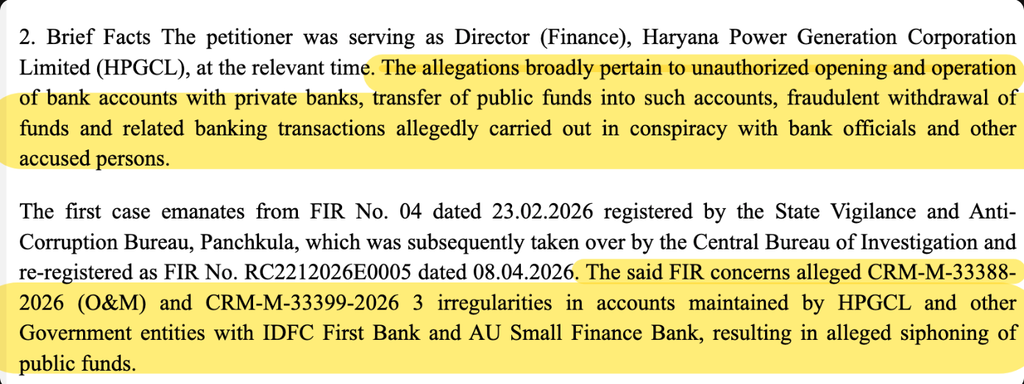
Source: Indian Kanoon — Amit Dewan v. CBI
The move was allegedly justified through an offer of 14% compensatory interest. But investigators allegedly found that the bank had not actually offered such a rate. Instead, according to the CBI’s case, the additional amount was allegedly arranged privately by accused individuals and funded through entities connected to the wider scheme.
That creates a question:
Why would a government body move an existing fixed deposit if the promised financial advantage was not a genuine bank offer?
The CBI alleges that the answer lies in the wider arrangement to benefit specific bank branches and officials.
What Did Officials Allegedly Receive?
According to the CBI allegations reported in the latest chargesheet, some officials allegedly received benefits in different forms. The alleged inducements included:
- Cash payments running into crores
- Gold
- Luxury hotel stays
- Restaurant bills
- Liquor
- Parties
- “Mujra” performances
- Alleged arrangements for escorts
- Hawala payments
The agency alleges these benefits were linked to officials helping facilitate the movement or placement of government funds.
Importantly, these are allegations contained in the CBI’s chargesheet and have not been established as facts by a court.
Pankaj Agarwal: The Alleged Administrative Link
The CBI alleges that IAS officer Pankaj Agarwal, who was then chairman of the Haryana State Agricultural Marketing Board (HSAMB), played a central role in facilitating the alleged arrangement.
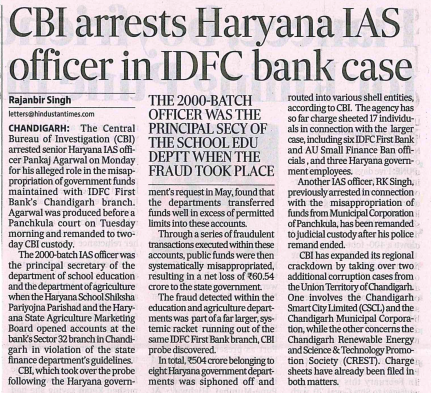
According to the agency, Agarwal allegedly received various “undue advantages”, including luxury hospitality and parties allegedly arranged by Ribhav Rishi, described as an alleged mastermind and former IDFC First Bank manager.
The CBI further alleges that Agarwal introduced Rishi to a senior departmental financial official before the proposal to open an IDFC account had originated within the department. The agency also questioned what happened after an alleged ₹10 crore fraudulent debit from an HSAMB account surfaced in February 2026.
According to the allegations, instead of immediately escalating the matter to the bank, Finance Department or law-enforcement authorities, the transaction was allegedly played down.
The Hawala Trail
The alleged money trail becomes even more difficult to follow in the case of Ram Kumar Singh, then Commissioner of the Panchkula Municipal Corporation. The CBI alleges that Singh facilitated the placement of municipal funds with IDFC First Bank and received crores through multiple hawala transactions.
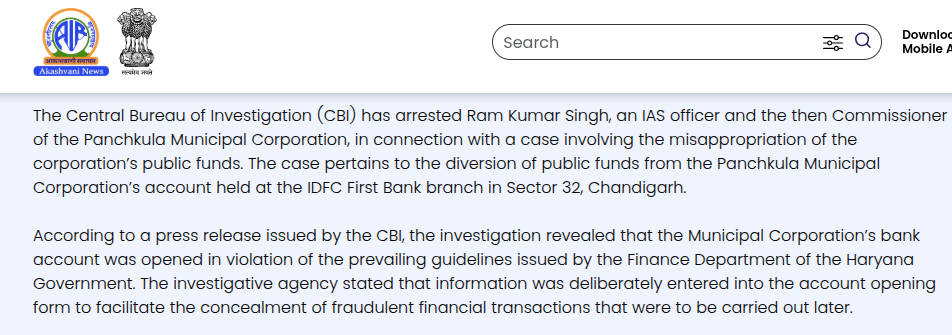
Investigators reportedly allege that some payments were delivered at his Chandigarh residence. The agency has also flagged the speed with which a major transaction was allegedly pushed through.
A quotation process allegedly gave banks only until the following day to respond, after which the evaluation, approval, premature withdrawal of deposits and creation of ₹80 crore in fixed deposits were completed within a very short period.
For investigators, the question is not simply whether the transaction happened. It is why the entire process moved so quickly and whether the outcome had effectively been decided in advance.
Gold, Cash and the HSPCB Connection
The CBI has also alleged that Vineet Garg, then chairman of the Haryana State Pollution Control Board (HSPCB), facilitated IDFC First Bank’s entry into the board’s banking arrangements.
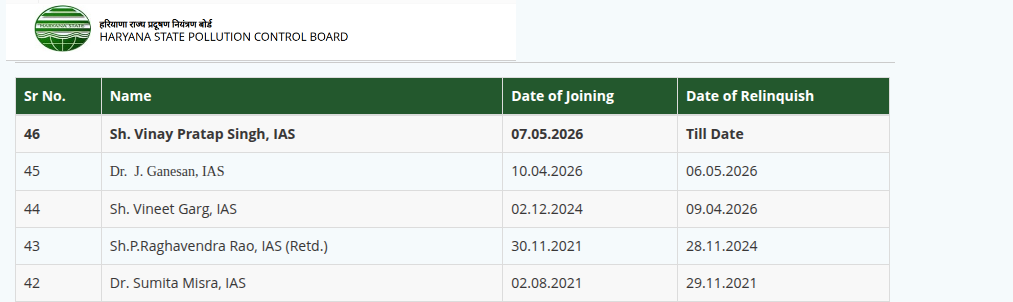
Investigators allege that Garg received cash worth crores and gold worth lakhs through a middleman.
The agency has also questioned changes in the way the HSPCB handled its banking process and alleged that Garg personally vetted relevant files. The larger pattern alleged by investigators is therefore becoming clearer:
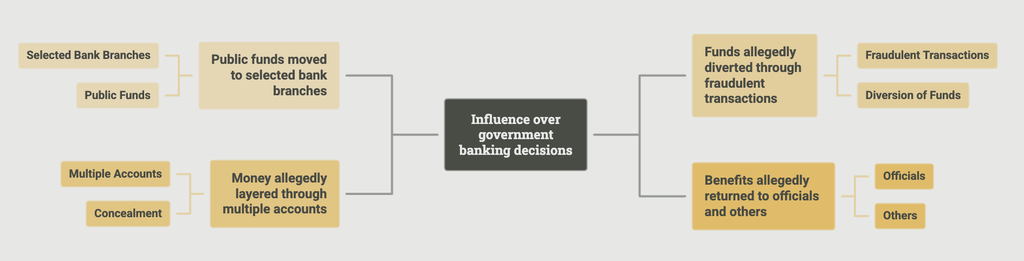
That is the core of the CBI’s money-trail theory.
The investigation is still continuing. And with 37 people now charge sheeted, the case is no longer simply about a missing amount in a government account. It is about whether a network of officials, bankers and private individuals allegedly worked together to move public money – and whether some of the resulting benefits were disguised as ordinary personal expenses, business transactions or other forms of gratification.
The chargesheet contains allegations, not convictions. The evidence will ultimately have to stand scrutiny before the court.
Read more news like this – A Fake Loan Approval Letter Is Circulating