
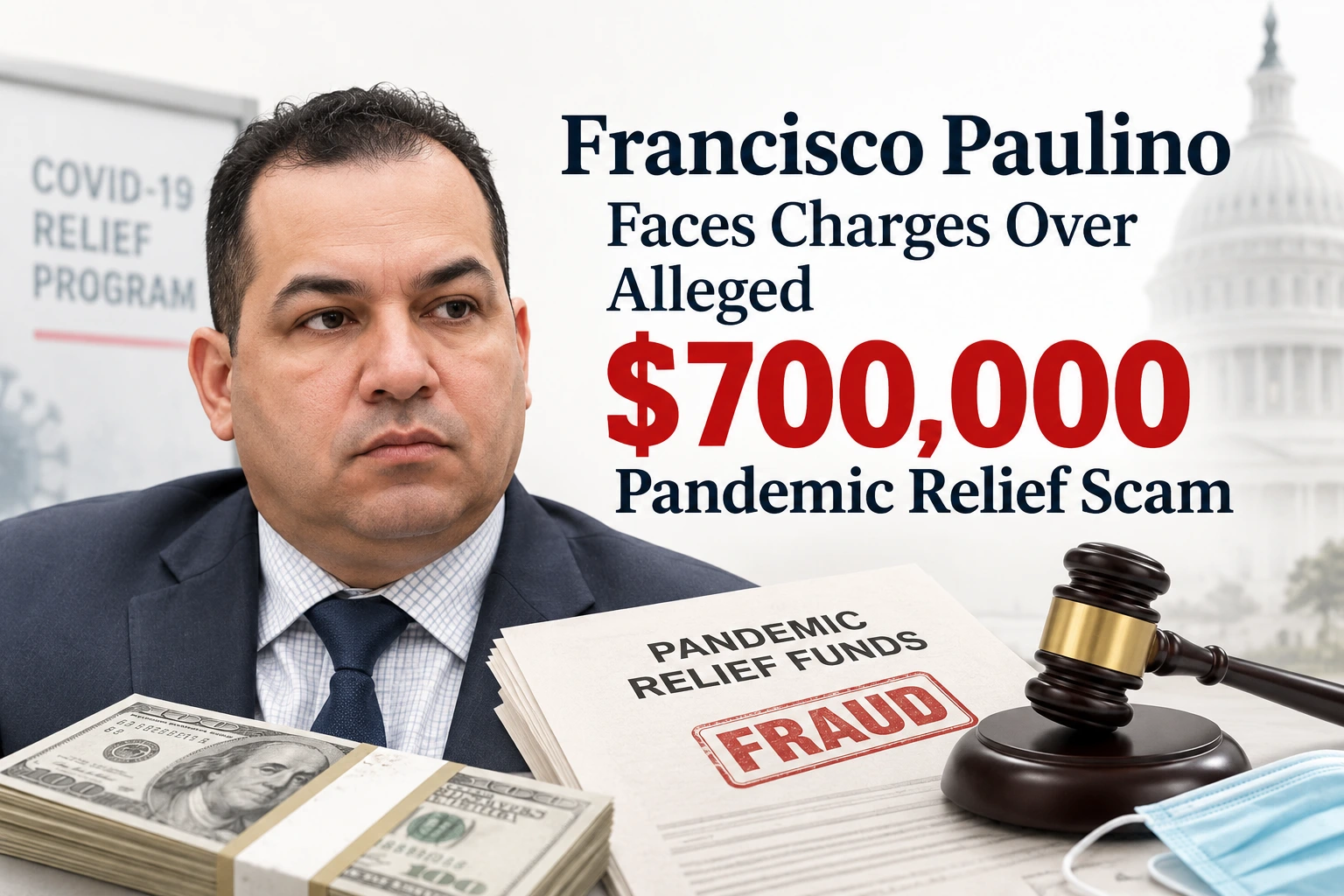
A Massachusetts state representative, Francisco Paulino, is facing serious federal charges over allegations that he misused more than $700,000 in pandemic relief money.
The case has attracted attention because the funds involved were part of government programs created to help unemployed people and struggling businesses survive the financial impact of the COVID-19 pandemic.
Paulino was arrested and charged with multiple federal offenses related to alleged wire fraud and unlawful monetary transactions. He has pleaded not guilty, and the allegations against him have not been proven in court.
How the alleged scheme worked
According to federal prosecutors, the alleged fraud began during the pandemic, before Paulino became a state representative.
One of the allegations involves Pandemic Unemployment Assistance, a program designed to provide financial support to people who lost work because of COVID-19.
Prosecutors allege that Paulino used the identity of a 77-year-old relative without that person’s knowledge to apply for unemployment benefits. The application allegedly claimed that the relative had worked for Paulino’s tax-preparation business, Madison Tax LLC.
Investigators say false documents and weekly certifications were also submitted as part of the application.
More than $44,000 in unemployment benefits was allegedly paid through this arrangement between 2020 and 2021.
Allegations involving business loans
The case also involves pandemic-related loans provided to businesses.
Federal prosecutors allege that businesses connected to Paulino received Economic Injury Disaster Loans through the U.S. Small Business Administration.
One of the businesses mentioned in the case is Jackson Enterprise Inc., which was set up as a fast-food restaurant and café. Prosecutors allege that the business had little or no legitimate revenue before receiving pandemic assistance.
Madison Tax was also allegedly approved for pandemic-related loans. According to the allegations, the company received more than $400,000 through two Economic Injury Disaster Loans.
Investigators are now examining whether the businesses were eligible for the money and how those funds were subsequently used.
Where did the money allegedly go?
One of the central questions in the case is what happened to the money after it was received.
Prosecutors allege that some of the pandemic relief funds were moved between businesses connected to Paulino. They also claim that some of the money was used for expenses that were not permitted under the relevant relief programs.
The allegations include spending on real estate expenses, loan payments and transfers involving a political campaign account.
Investigators are also examining financial transactions involving a mortgage company connected to Paulino and property purchases.
The financial trail could become an important part of the prosecution’s case as authorities attempt to establish how the money was obtained and where it ultimately went.
Why Francisco Paulino’s case stands out
The allegations would be serious in any case, but they have received additional attention because Paulino is an elected public official.
Francisco Paulino was elected to the Massachusetts House in 2022. The conduct described in the federal charges, however, largely relates to 2020 and 2021, before he entered the State House.
The case therefore concerns alleged conduct from a period before Paulino began his political career, while also raising questions about how the charges could affect him as a current public official.
Paulino pleads not guilty
Francisco Paulino has pleaded not guilty to the charges.
That point is important. An indictment represents allegations brought by prosecutors; it is not a finding of guilt. Paulino is presumed innocent unless and until the charges are proven in court.
The legal process will determine whether the government’s evidence is strong enough to establish that he knowingly committed the alleged offenses.
A wider problem with pandemic relief
The allegations against Paulino are also part of a much larger story surrounding pandemic-era fraud.
During COVID-19, governments distributed huge amounts of emergency financial assistance. The aim was to get money to unemployed workers and struggling businesses as quickly as possible.
That urgency, however, also created opportunities for fraud.
Authorities across the country have investigated cases involving false identities, fake businesses, fabricated documents and misleading information used to obtain government assistance.
Even years after the pandemic, investigators continue to trace financial records and pursue people suspected of improperly obtaining relief funds.
What happens next?
The federal case against Francisco Paulino will now proceed through the court system.
Investigators and prosecutors are expected to examine financial records, bank transactions, business documents, loan applications and other evidence.
Among the key questions are whether false information was knowingly submitted, whether the businesses involved were eligible for pandemic assistance and whether the money was deliberately used for purposes outside the programs’ rules.
The court will ultimately determine whether the government’s allegations can be proven.
The bigger picture
At the heart of the case is money that was intended to help people during an extraordinary economic crisis.
For many Americans, pandemic relief was a lifeline that helped them pay bills, retain employees or keep businesses operating. Alleged misuse of those funds therefore raises concerns that go beyond the financial loss itself.
At the same time, the legal principle remains clear: being charged does not mean being guilty.
Francisco Paulino will have the opportunity to defend himself in court, while prosecutors must prove their allegations with evidence.
Whatever the eventual outcome, the case illustrates the continuing effort by U.S. authorities to investigate pandemic relief fraud and recover money that may have been obtained improperly.
-

Shivam Associates Belgaum Scam: What Happened and What Investors Should Know
The Shivam Associates scam in Belgaum, Karnataka, has become a major financial controversy, leaving thousands…
-

ED Arrested Utkarsh Chandrakar, CGPSC Recruitment Scam
The Enforcement Directorate just locked up Utkarsh Chandrakar in the massive CGPSC recruitment scam. Federal…
-

₹504 Crore Haryana Funds Scam: How Public Money Allegedly Moved From Government Accounts to Luxury ‘Favours’
A government account is supposed to be one of the safest places for public money…
