
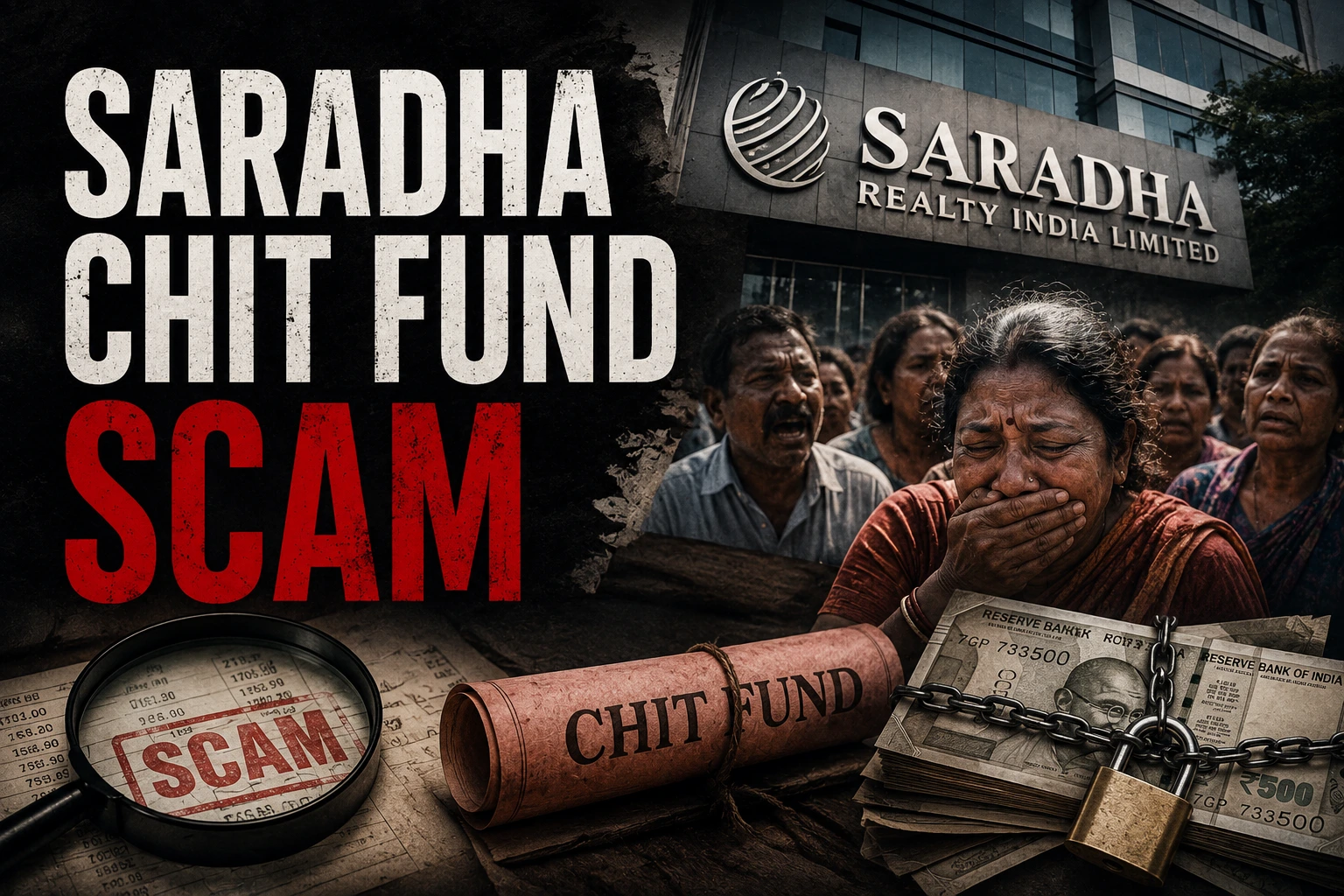
The Saradha chit fund scam remains one of India’s most prominent financial scandals, more than a decade after the collapse of the Saradha Group in 2013. The case involved allegations that the group mobilised large sums of money from ordinary investors through a network of companies and agents, before the scheme collapsed and thousands of depositors were left facing substantial financial losses.
The legal proceedings have continued for years, involving the Central Bureau of Investigation (CBI), the Enforcement Directorate (ED), various courts and several accused persons. A significant recent development came in August 2026, when the Supreme Court granted bail to Saradha Group director Sudipta Sen after nearly ten years in custody in the CBI case.
What was the Saradha scam?
The Saradha Group operated a large network of companies and collected money from investors, particularly in West Bengal and neighbouring eastern states. The group’s collapse in 2013 triggered widespread concern because many small investors had placed their savings in its schemes.
Although commonly called a “chit fund scam”, the Saradha operation has generally been described in court proceedings and investigative reports as involving a Ponzi-type financial scheme and illegal collection of public deposits, rather than a conventional chit-fund business.
The scale of the operation was enormous. The group reportedly had a complex network of companies and businesses, while allegations centred on the collection and diversion of investors’ money.
How did the scandal come to light?
The crisis became public in April 2013, when the Saradha Group collapsed and investors began reporting that they could not recover their money.
The collapse had a major social and political impact in West Bengal. Thousands of small investors and agents were affected, and the issue quickly became a major political controversy.
The West Bengal government established an inquiry mechanism following the collapse, while criminal investigations were subsequently pursued by state and central agencies.
The Supreme Court later transferred the investigation into the Saradha case and other related matters to the CBI. The investigations subsequently expanded into allegations concerning money laundering, financial transactions and possible involvement of other individuals and entities.
The role of the CBI and ED
The CBI has investigated criminal aspects of the Saradha Group’s activities, including allegations relating to the mobilisation and diversion of investors’ money.
The Enforcement Directorate (ED) has separately pursued money-laundering aspects of the case under the Prevention of Money Laundering Act.
The case has also involved investigations into alleged financial links between Saradha-related funds and various individuals and organisations. Allegations against particular people have been contested, and an allegation or investigation should not be treated as proof of guilt unless established by a court.
Latest major development: Supreme Court grants bail to Sudipta Sen
The most significant recent development is the Supreme Court’s August 18, 2026 order granting bail to Sudipta Sen, a director of the Saradha Group.
According to the reported Supreme Court proceedings, Sen had been in custody since December 30, 2016. The Court considered the length of her incarceration and ordered that she be released on bail on terms to be fixed by the trial court.
The case is identified as Sudipta Sen v. Central Bureau of Investigation, Criminal Appeal arising out of SLP (Criminal) No. 10924 of 2026. The bench comprised Justices Sanjay Karol and Augustine George Masih.
Importantly, bail does not amount to an acquittal. It means that the accused is allowed to remain out of custody while the relevant legal proceedings continue, subject to the conditions imposed by the court.
The Supreme Court’s recent order is therefore an important procedural development, but it does not bring the Saradha investigations or all related criminal proceedings to an end.
What about the other cases?
The Saradha matter is not a single criminal proceeding involving only one accused. Over the years, several investigations and court proceedings have arisen from different aspects of the group’s activities.
The courts have also considered cases involving people accused of facilitating or benefiting from transactions connected with the Saradha Group. The ED’s own legal bulletin, for example, records proceedings concerning financial dealings involving entities connected with chit-fund investigations and the attachment of properties under the PMLA.
Separately, proceedings concerning former Kolkata Police commissioner Rajeev Kumar have remained part of the wider legal history surrounding the Saradha investigation. Recent reports indicate that the Supreme Court has been dealing with a CBI challenge concerning his anticipatory bail.
Why has the case taken so long?
The Saradha investigation is unusually complicated because of the number of companies, investors, transactions and individuals involved.
There are also multiple layers of proceedings: criminal cases, investigations by central agencies, property-attachment proceedings under the PMLA, bail applications and appeals.
The long duration of custody of some accused persons has itself become an issue before the courts. In its recent decision concerning Sudipta Sen, the Supreme Court specifically took into account the fact that she had spent almost ten years in custody.
The Supreme Court has previously emphasised that economic offences cannot automatically be treated as a separate category in which bail is denied merely because the allegations are serious; the circumstances of each case and the progress of proceedings remain relevant.
What does the latest development mean for investors?
For investors who lost money in the Saradha collapse, the latest bail order does not itself mean that their claims have been settled or that recovery proceedings have ended.
The recovery of money and distribution of assets are separate issues from the criminal prosecution of the accused. Property and assets identified during investigations can be subject to legal proceedings, attachment and eventual adjudication.
The central question for affected investors remains how much money can ultimately be recovered and distributed through the mechanisms established by the courts and authorities.
Saradha scam: why it still matters
The Saradha scandal continues to be relevant because it exposed serious vulnerabilities in the financial system available to ordinary savers.
Many investors were attracted by the promise of attractive returns and relied on agents or intermediaries. The collapse demonstrated the risks associated with placing savings in financial schemes without checking whether the entity and product are properly regulated.
The scandal also became a major example of how financial fraud can develop into a wider governance and political controversy when large numbers of small investors are affected.
What happens next?
The latest Supreme Court bail order means that the legal story is still continuing rather than concluding.
The key developments to watch are:
- Progress of the remaining CBI criminal proceedings.
- Further hearings involving other accused persons.
- ED proceedings concerning alleged proceeds of crime and attached assets.
- Court decisions relating to the recovery and distribution of investors’ money.
- Further Supreme Court and High Court orders in connected cases.
More than 13 years after the Saradha Group collapse, the case remains a long-running legal and financial saga. The August 2026 Supreme Court decision granting bail to Sudipta Sen after nearly a decade in custody is the latest major development, but it does not resolve the wider Saradha cases.
The ultimate conclusion of the scandal will depend on the outcome of the pending criminal proceedings, investigations into the flow of funds, adjudication of attached assets and the mechanisms available for compensating affected investors.
For the public, the Saradha episode remains a powerful reminder that unusually high-return investment promises can carry substantial risks-and that investors should verify whether a financial product and the organisation offering it are properly regulated before committing their savings.
Also read about DJB Scam
-

Shivam Associates Belgaum Scam: What Happened and What Investors Should Know
The Shivam Associates scam in Belgaum, Karnataka, has become a major financial controversy, leaving thousands…
-
ED Arrested Utkarsh Chandrakar, CGPSC Recruitment Scam
The Enforcement Directorate just locked up Utkarsh Chandrakar in the massive CGPSC recruitment scam. Federal…
-

₹504 Crore Haryana Funds Scam: How Public Money Allegedly Moved From Government Accounts to Luxury ‘Favours’
A government account is supposed to be one of the safest places for public money…
